

Taking a Nested Approach to Your Relationship Building

Connection is the reason that policy networking can come as naturally to introverts as it does to extroverts. While having lots of contacts can be useful sometimes, the quality of your relationships matters more than the number of people in your address book when you actually need help with something. If you need anything that requires more than a couple of minutes of someone’s attention, you’re unlikely to get anything meaningful back by crowdsourcing on social media. Rather, you need to go to people with whom you have social capital.

You already have your 3i analysis to guide you to the right teams in the most relevant organisations, but the number of people you could potentially reach out to can be overwhelming. It isn’t uncommon to identify over 100 organisations in a 3i analysis, and you don’t have time to reach out to even a fraction of them, let alone build relationships with them. As a result, you may want to take a nested approach to your relationship building. You may regularly connect on a superficial level with two or three key organisations in each category of your 3i analysis, resulting in electronic communication with 10-15 people from different organisations in the course of a typical month.
But within each main category, there are a small number of people who you might want to stay in close contact with, doing what you can to make time for them and help them when they reach out to you.
Bonding vs bridging connections
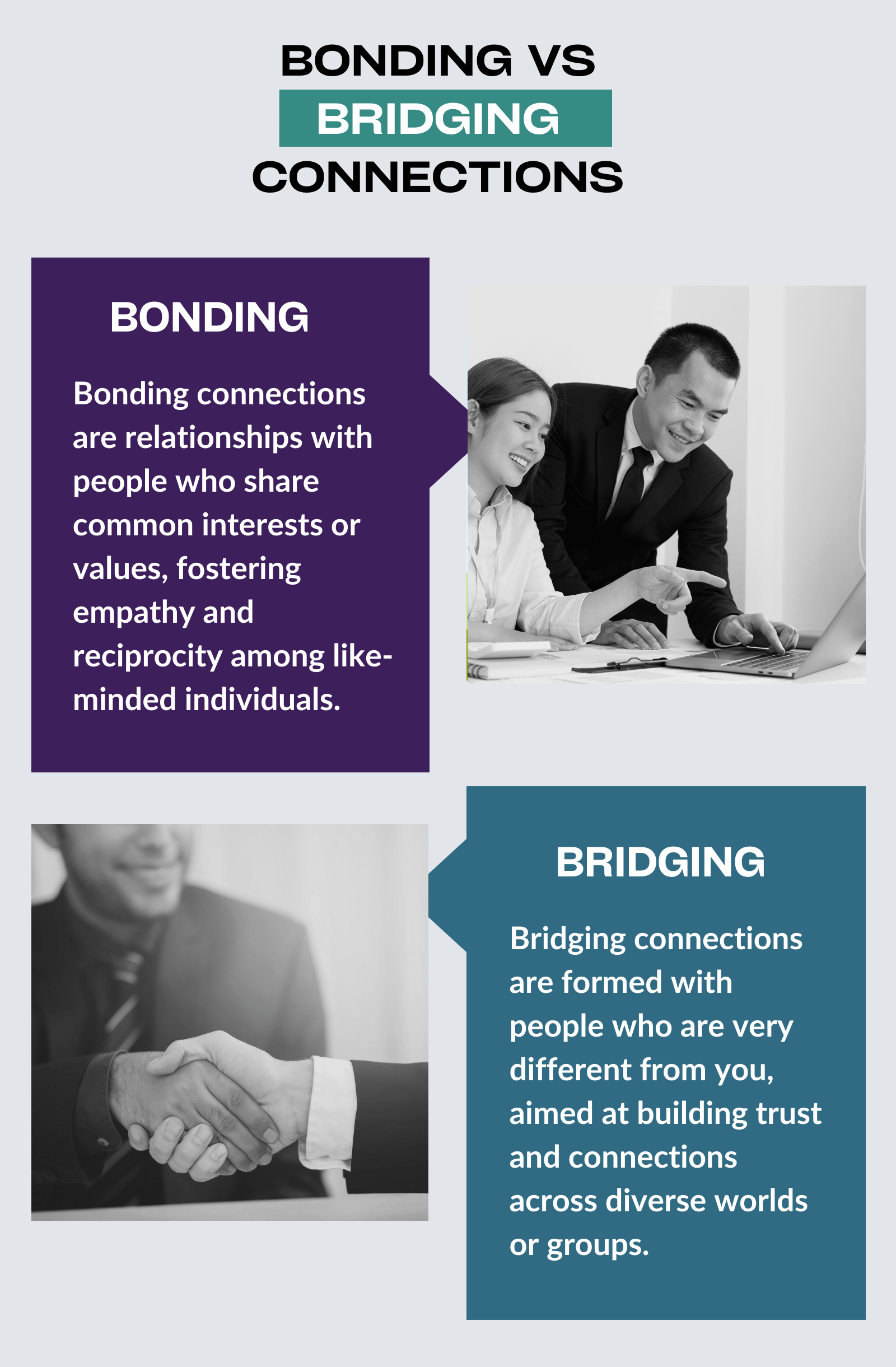
Some of these relationships might be ‘bonding’ connections, in which you share something important in common, despite your apparent differences. For example, you may share bonding connections with researchers from different disciplines or friends with different political views who share your passion for the environment and who want to tackle the climate emergency using the best available evidence. Because bonding connections are typically with like-minded people, it is easy for them to empathise with you when you are in need, and as a result, networks of people with bonding connections often have a high degree of reciprocity. However, if you want to make a difference, there are two other types of connection that you need to cultivate: ‘bridging’ connections and cross hierarchical connections.
‘Bridging’ connections occur when you cultivate relationships with people who are very different to you. Typically, people think about the ability to create bridges of trust between different worlds, and for most researchers, building relationships with people outside academia is how you will create a bridging connection. But it can go much deeper than just creating bridges between the worlds of scholars and charities, or science and policy.
Cultivating trust and empathy for impactful connections
The hardest and most rewarding bridges are those we build to people who are fundamentally different, even objectionable, to us. Learning how to trust, and be trustworthy with people that we instinctively distrust requires advanced empathy skills. This is not just being friendly to people to build social capital that you can ‘cash in’ at a later date, while criticising them behind their backs. This is understanding and respecting people enough that you speak well of them behind their backs, even when you know others will judge you.
For example, conservationists may not be respected by others in their discipline if they work with controversial companies, or protect the interests of farmers, given the impact each of these groups have had on the environment. But while it is easy to demonise a company or group, it is much harder to think badly of an actual farmer who is telling you everything they are doing to nurture nature on their farm, or a sustainability officer who wants to transform a company’s supply chains to protect and restore nature.
When you connect with these people’s passion, and see their heart, you can’t help but build bridges of trust, even if you disagree with some of their beliefs and practices. Once you get to a person’s values, it is difficult not to find something that resonates with you.
Cross-hierarchical connections for impact
To achieve impact, researchers have a unique responsibility to foster ‘bracing’ connections between different hierarchical levels within their networks. This might include, for example, facilitating a connection between a farmer who has a great idea and a policy maker who might be able to act on that idea. However, it can be a challenge to create trusting relationships with people who occupy different hierarchical levels than you. If they are above you in the hierarchy, you may be invisible to them, and if they are below you, they may instinctively distrust you as one of the ‘elite’ who is probably ‘out of touch’ with people like them.